
How Names Change Across Languages
Personal names rarely stay unchanged when they move from one language to another. Sound systems, alphabets, religion, migration, and local tradition all shape the way a name is spoken and written. That is why one original form can produce many familiar versions in different countries. Looking at these transformations reveals not only the history of names, but also the history of cultural contact, adaptation, and identity.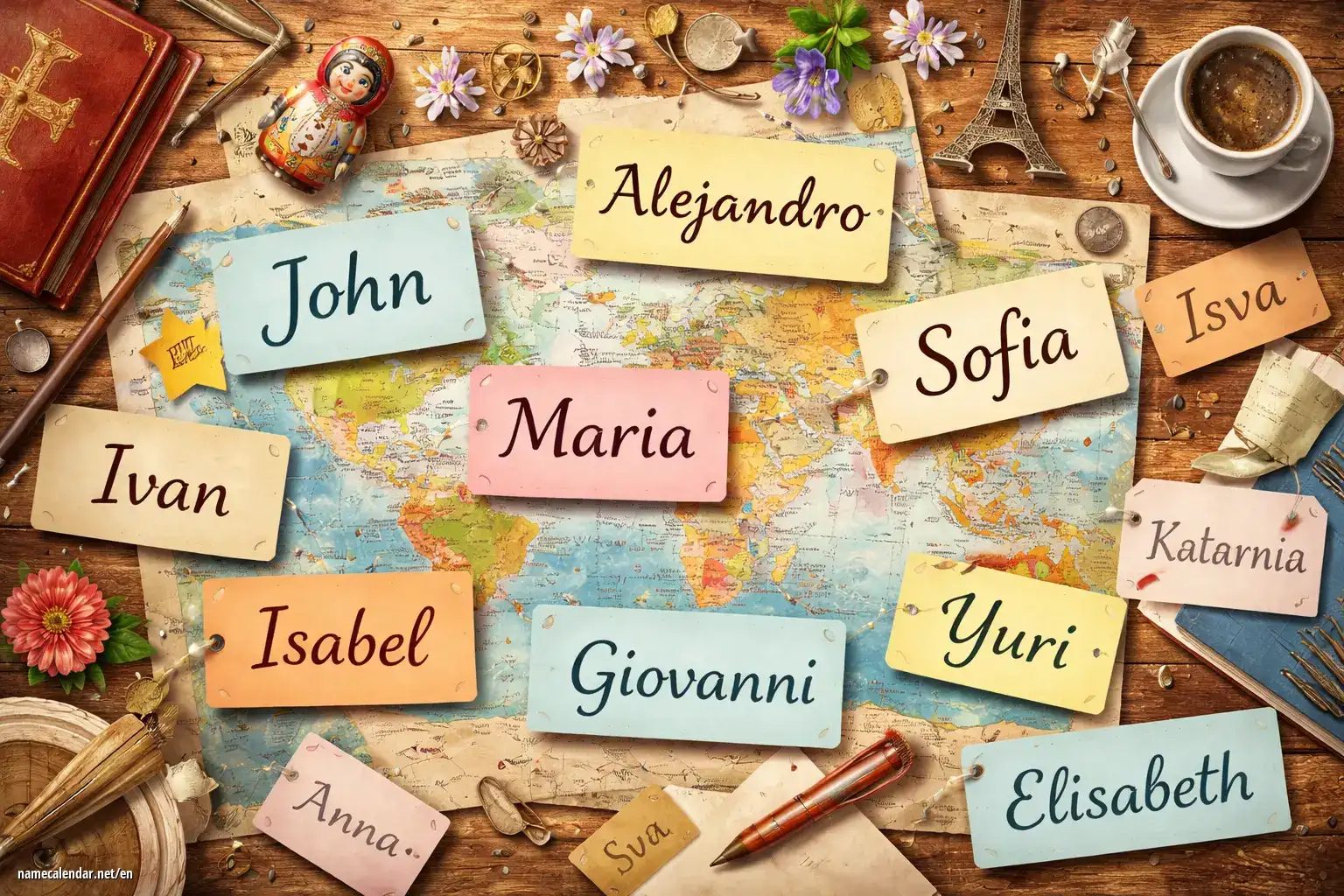
Why names change when languages meet
A given name may seem fixed, but in reality it is highly flexible. When a name enters a new language, speakers often adjust it to fit local pronunciation patterns. A language that does not use certain consonants, vowel combinations, or endings will naturally reshape the name into something easier to say. Over time, that adapted form begins to feel native, even when its roots lie elsewhere.Religion has played a major role in this process. Biblical, saintly, royal, and heroic names spread across Europe, the Middle East, and beyond through sacred texts, oral tradition, and political power. As those names traveled, they were translated, transliterated, shortened, softened, or remodeled. A single ancient form could develop into a whole family of related names, each one carrying the same distant ancestry but a distinct local identity.
Writing systems also matter. A name written in Greek, Latin, Cyrillic, Arabic, Hebrew, or another script does not always move neatly into the alphabet of another language. Some changes happen because of sound, others because of spelling, and others because of long historical habits. That is why related names can sometimes look very similar and at other times appear almost unrelated until their history is traced more carefully.
The same origin, many forms
How one name becomes a network of variants
Many of the most widely recognized names in the world belong to clusters rather than isolated forms. A cluster begins with one older source and develops branches in many languages. These branches may preserve the original meaning while changing their sound, spelling, rhythm, or emotional tone. Some versions sound formal, some warm and domestic, and some strongly tied to a certain nation or era.For example, people may not immediately connect John, Jean, Juan, Giovanni, Ian, Ivan, Johann, and Sean, yet these names belong to the same broad historical family. They do not look identical because each language has shaped the original inherited material in its own way. Once seen together, however, they form a remarkable map of linguistic and cultural exchange.
This is one reason name history is so fascinating. Names are small pieces of evidence that preserve the routes by which ideas, faiths, and people moved. A form that feels completely local may actually be part of a much older international story.
The long journey of John
From ancient roots to European diversity
The family surrounding John is one of the clearest examples of a name changing across languages. Its distant roots lie in the Hebrew form Yohanan, which passed through Greek and Latin before spreading into many vernacular traditions. At each stage, sounds shifted and endings changed until separate national forms emerged.In English, the best-known form became John. In French, the equivalent settled as Jean. Spanish developed Juan, while Italian preferred Giovanni. German-speaking regions used Johann and later also Hans as a shorter popular form. In Slavic traditions, Ivan became extremely important, while Scottish Gaelic and Irish traditions produced forms such as Ian and Sean.
These names feel culturally specific, yet they reflect the same inherited tradition. Their differences show how each language applies its own sound patterns. French favored a softer ending in Jean, Spanish simplified the initial sound into Juan, Italian preserved a fuller melodic structure in Giovanni, and Slavic speech patterns gave strength to Ivan. The result is not random change, but orderly adaptation.
What this family of names reveals
The story of John demonstrates that names can cross borders without losing their core identity. Even when spelling changes dramatically, people often continue to recognize the form as equivalent in meaning or tradition. This is especially true in families where the same saint, ancestor, or biblical figure inspired naming in different countries.It also shows that names are never only linguistic objects. A family with roots in Spain may use Juan, while a branch in France may prefer Jean, and an English-speaking generation may choose John. Different forms can honor the same heritage while expressing different cultural belonging.
Maria, Mary, Marie, and other feminine transformations
A name that crossed almost every border
If John is one of the great international masculine name families, then Maria is one of the most powerful feminine examples. This name traveled widely through Christian tradition and took root in dozens of languages. English commonly developed Mary, French established Marie, Spanish and Portuguese kept Maria, while Eastern Europe often used forms such as Maria, Marija, or Mariya.Some variants remain very close to the older form, while others feel more clearly transformed. The English Mary is shorter and sharper in sound. French Marie adds its own rhythm and elegance. In many languages, Maria remained stable because its vowel pattern fit local speech well. This shows that names do not always need dramatic change. Sometimes a language accepts a borrowed form almost intact because it already sounds natural.
From sacred use to everyday life
The success of the Maria family also reveals how names can move from sacred association into daily use. A name first valued for religious reasons may later become timeless, classic, and widely admired even outside strong religious settings. That helps explain why one name can survive for centuries while still producing affectionate or fashionable local forms.Diminutives and related forms add another layer. From the same broad tradition came names and pet forms such as Marie, Mary, Masha, Marija, Maija, and Marietta. Some function as official names, others as familiar forms, and some rise to independence. Over time, what began as a variation may become a distinct name in its own right.
Alexander and the prestige of classical names
Royal, heroic, and adaptable
Names linked to rulers, conquerors, and heroic memory often travel especially well. Alexander is a strong example. The prestige of Alexander the Great helped the name spread across many regions, and later Christian and royal use kept it alive. Yet the form changed according to local language habits. English uses Alexander, French Alexandre, Spanish Alejandro, Italian Alessandro, Russian Aleksandr, and Greek preserves forms closer to its classical heritage.Although all of these versions are recognizably related, each carries a different sound image. Alejandro feels unmistakably Spanish, Alessandro strongly Italian, and Alexandre elegantly French. The identity of the name remains, but the cultural music changes. This is one of the most beautiful aspects of cross-language name history: the same name can be shared, yet never sound exactly the same everywhere.
Short forms and modern usage
Another reason Alexander has stayed international is its flexibility. It produces short forms easily: Alex, Alec, Sasha, Sandro, and others. Some of these are tied to one language, while others travel widely on their own. A short form may eventually become more fashionable than the full version, especially in modern naming culture where brevity and informality are often valued.This pattern is common with names that spread across languages. A prestigious historical form anchors the family, while shorter local adaptations help the name remain alive in everyday use. That balance between tradition and convenience is one reason certain names keep renewing themselves over generations.
When a name changes more than expected
Catherine, Katherine, Catalina, and Ekaterina
Some name families show moderate change, but others become surprisingly diverse. The tradition behind Catherine is a good example. English gives us Catherine and Katherine, French uses Catherine, Spanish has Catalina, Italian developed Caterina, Russian created Ekaterina, and many other languages formed their own versions.At first glance, Catalina and Ekaterina may not appear close, yet both belong to the same historical family. The reasons for this wider divergence include different transmission routes, the influence of Latin or Greek forms, and the way each language handles consonant clusters and endings. This shows that cross-language equivalence is not always visually obvious.
The role of spelling tradition
Names also carry the memory of older spelling systems. The alternation between Catherine and Katherine reflects more than personal preference. It shows how languages and periods have represented similar sounds differently. Over time, spelling can become symbolic, with one form feeling more classic, another more modern, and another more regionally specific.Because of this, people choosing a name often consider not only origin and meaning, but also which linguistic branch feels closest to their family identity. A parent may love the broader tradition but prefer Caterina over Katherine because the sound better matches Italian heritage, or choose Ekaterina because it preserves a strong Slavic connection.
George, Jorge, Yuri, and the hidden links between names
Related forms are not always obvious
Some families of names teach an important lesson: related forms can become so different that the connection is hidden. The tradition behind George spread through Greek and Christian usage into many languages. English has George, French Georges, Spanish and Portuguese Jorge, Italian Giorgio, and several Slavic traditions adapted the name in their own ways.In some naming histories, forms associated with the same saint or older root diverged enough that ordinary speakers no longer recognize them as equivalents. A name may be reshaped by centuries of sound change, local pronunciation, or different transliteration practices. That is one reason name study often surprises readers. A familiar local form may turn out to be cousin to a foreign name that seems unrelated at first sight.
Why hidden relationships matter
These hidden links matter for genealogy, cultural history, and naming choice. Families tracing ancestors across borders may miss connections if they search only for exact modern spelling. Likewise, people looking for international equivalents of a favorite name may discover a much broader range than expected. Understanding that George, Jorge, and Giorgio belong to one tradition opens a wider appreciation of how names travel.This broader view also reminds us that a name does not need to look identical to carry shared heritage. The family resemblance may live in history rather than in present-day spelling.
Elizabeth and the elegance of branching forms
One name, many personalities
The family around Elizabeth is especially rich because it produced both formal international variants and a large number of everyday forms. English uses Elizabeth, French often has Elisabeth, Spanish Isabel, Italian Elisabetta, and many Slavic languages adapted the name in their own phonetic patterns.What makes this family remarkable is not only the number of forms, but the difference in style between them. Elizabeth sounds stately and traditional. Isabel feels shorter and warmer. Elisabetta has an ornate musical quality. From these come even more branches, such as Eliza, Elsa, Lisa, Beth, and Liesbeth. Some remain nicknames, while others become established given names in their own right.
How shortening creates new names
This family shows another important process: shortening can create names that feel independent from the original. A child named Elizabeth may be called Eliza or Beth, and later those shorter forms may be given officially to new generations. Over centuries, the connection to the longer source can fade in everyday awareness.For name lovers, this is especially interesting because it reveals how language and affection interact. Formal religious or royal names often survive partly because they can generate softer and more intimate forms for daily life. A name that adapts to both ceremony and familiarity has strong survival power.
Anna, Hannah, Ana, and the power of simplicity
Why some names travel with little change
Not every name changes dramatically. Some travel across languages with relatively small adjustments because their structure is simple and widely pronounceable. The family around Anna illustrates this clearly. Forms such as Anna, Ana, Anne, Hannah, and Anya show variation, yet the core is still easy to recognize.The reason is partly phonetic. A short sequence of open vowels and common consonants fits many languages with little resistance. When a name is easy to pronounce, it often needs less reshaping. That helps explain why Anna appears across Europe and beyond with remarkable continuity.
Small changes can still carry strong identity
Even minimal variation, however, can matter a great deal culturally. Anne feels different from Ana, and Hannah carries a distinct Biblical and English-language presence compared with the more internationally neutral Anna. A single added consonant or altered ending may signal language, religion, or family tradition.This reminds us that name change is not always about dramatic transformation. Sometimes the difference is subtle, but still meaningful. A very small shift can place a name firmly within a certain linguistic world.
Names crossing alphabets and scripts
Transliteration changes the appearance of names
One of the biggest reasons names change form is script. When a name moves from Cyrillic, Greek, Hebrew, Arabic, or another writing system into the Latin alphabet, there is often more than one possible way to represent it. This can create parallel spellings that all refer to the same underlying name.For instance, the name behind forms such as Sofia and Sophia may appear with one spelling in one language and another elsewhere. The same happens with names like Nikolai, Mykhailo, Yusuf, or Yehoshua, which may take several written forms depending on how sounds are transferred into another alphabet. Differences in transliteration can make a name look newer, older, more international, or more faithful to the source language.
Pronunciation versus tradition
Sometimes a spelling tries to match pronunciation closely. At other times, it follows historical convention even if the result is less intuitive to outsiders. This tension explains why one language may write a name one way while another prefers a spelling that seems less phonetic. Both are following internal logic.For families living between languages, this question can become very personal. Choosing whether to preserve the original script-based form or adopt a more locally readable version is often a balance between heritage and practicality. In that sense, the way a name is written becomes part of identity itself.
Migration, empire, and the spread of name variants
Historical movement leaves traces in names
Names do not travel on their own. They move with merchants, missionaries, soldiers, royal marriages, migration, literature, and education. Every major period of cultural contact leaves behind a layer of name exchange. A classical name may spread through empire, a biblical name through religion, and a fashionable court name through prestige and imitation.This is why some name families have especially broad reach. The variants of Maria, John, Alexander, Anna, and Elizabeth followed routes shaped by powerful institutions and long historical continuity. By contrast, other names remained more local because they lacked the same channels of transmission.
Adaptation does not mean loss
It can be tempting to think that a name loses authenticity when it changes form, but history suggests the opposite. Adaptation is often what allows a name to survive. A name that remains rigid may stay limited to one language community. A name that adapts can enter many homes and traditions without disappearing.That is why local forms should not be seen as lesser copies of an original. Juan is not a weakened version of John, and Giovanni is not a distortion. Each is a complete cultural form with its own literary, historical, and emotional life. Shared roots create kinship, but each language gives the name a full identity of its own.
What name variants mean for modern parents and readers
Choosing a name with international depth
For modern parents, understanding how names change across languages opens valuable possibilities. A name can be chosen not only for its sound in one language, but for its relatives in others. Some families want a form that works internationally with minimal change, while others prefer a version that strongly reflects a particular heritage. Knowing the broader family of a name helps make that decision more thoughtful.A parent may love Sofia because it feels widely recognizable, or prefer Sophia because that spelling suits their language environment. Someone drawn to Alexander may choose Alejandro or Alessandro to emphasize cultural connection. Another family may like that Anna remains clear across many countries with only minor variation.
Useful for genealogy and cultural curiosity
Name variants are also important for readers interested in family history. Ancestors who moved across borders often had their names recorded differently by officials, churches, schools, or local communities. A person born with one spelling might appear in records under another. Recognizing cross-language relationships between names can therefore help uncover lost links in a family tree.More broadly, name variants encourage cultural curiosity. They invite people to look beyond the familiar spelling and ask where a name came from, how it traveled, and what other forms it has produced. A simple given name can become a doorway into language history, migration, religion, and literature.
Why these changes make names richer
The fact that names change across languages does not make them confusing. It makes them richer. Every variant carries evidence of adaptation, continuity, and local creativity. Some forms remain close to an ancient model, while others move far enough to seem newly invented. Yet both kinds of change reveal the same truth: names are living cultural forms, not museum objects.When we compare John with Jean, Juan, Giovanni, and Ivan, or Maria with Mary and Marie, we are not just looking at spelling differences. We are seeing how languages receive, reshape, and keep what matters to them. That process has been happening for centuries and continues today in every multilingual society.
In the end, names that changed form across languages remind us that identity can be both shared and local at the same time. A name may belong to a long international tradition while still sounding deeply at home in one particular language. That balance is part of what makes personal names so enduring and so endlessly interesting.